Visiting Cité du Vin in Bordeaux

Cité du Vin is Bordeaux’s immersive wine museum, best known for its multimedia permanent exhibition and the Belvedere tasting with panoramic city views. The visit feels less like a traditional museum and more like moving through a dark, interactive sequence of themed rooms with screens, sound, scent, and short films. Most people need 2–3 hours, and timing matters more than many expect, since weekend afternoons make the touchscreens and Belvedere queues much slower. This guide covers tickets, timings, routes, and what to prioritise.

Quick overview: Cité du Vin at a glance

If you want the short version before you book, this is what actually changes the visit.

  • When to visit: April–October is usually 10am–7pm daily, while winter hours are mostly 10am–6pm with some Saturday late openings; weekday mornings before 11am are noticeably calmer than Saturday 1pm–5pm because the interactive screens and Belvedere queue bottleneck once weekend and cruise traffic arrives.
  • Getting in: From €23 for standard entry, with tasting workshops from about €26 extra; same-day admission is often fine off-peak, but book at least 24–48 hours ahead for weekends, Via Sensoria, or a sunset-timed visit in July–September.
  • How long to allow: 2–3 hours for most visitors, and closer to 4 hours if you add a workshop, stop for the temporary exhibition, or want the Belvedere near sunset.
  • What most people miss: The Bordeaux-focused documentary and the temporary exhibition on Floor 1 are easy to skip, because most visitors stay on Floor 2 and go straight up to the Belvedere.
  • Is a guide worth it? Usually not for the main exhibition, because the Travel Companion already does a good job in 8 languages, but a workshop is worth it if you want a real guided tasting rather than the single included glass upstairs.

🎟️ Workshop slots for Cité du Vin can sell out 2–3 days in advance during July–September. Lock in your visit before the time you want is gone. → See ticket options

Jump to what you need

🕒 Where and when to go

Hours, directions, entrances, and the best time to arrive

🗓️ How much time do you need?

Visit lengths, suggested routes, and how to plan around your time

🎟️ Which ticket is right for you?

Compare all entry options, workshops, and special experiences

🗺️ Getting around

How the galleries are laid out and the route that makes most sense

🍷 What to see

Terroirs Table, Vineyard Flyover, Belvedere tasting

♿ Facilities and accessibility

Restrooms, lockers, accessibility details, and family services

Where and when to go

How do you get to Cité du Vin?

Cité du Vin sits in Bordeaux’s Bassins à Flot district on the left bank of the Garonne, about 3km (1.9 miles) from Place des Quinconces and easiest to reach by Tram B.

134 Quai de Bacalan / 1 Esplanade de Pontac, 33300 Bordeaux, France

→ Open in Google Maps

  • Tram: La Cité du Vin stop (Tram B) → 2-min walk → fastest route from central Bordeaux, usually 8–12 min from Quinconces.
  • River shuttle: BatCub pontoon near Cité du Vin → 3–5 min walk → best arrival if you want the riverfront exterior view first.
  • Taxi / rideshare: Drop-off at Esplanade de Pontac → 1–2 min walk → easiest from Bordeaux Saint-Jean with luggage.
  • Walk: From Place de la Bourse → 25–35 min along the quays → scenic, but exposed in summer heat.

→ Full getting there guide

Which entrance should you use?

Cité du Vin has 2 public entrances — one city-side and one river-side — but both lead into the same ground-floor Forum, so the common mistake is thinking one has a separate exhibition queue. If you already have an online ticket, the real time-saver is skipping the ticket desk and heading upstairs.

  • City-side entrance: Located at Esplanade de Pontac. Best for tram arrivals and on-site ticket buyers. Expect 5–20 min wait at the desk on summer weekends.
  • River-side entrance: Located on the quai side facing the Garonne. Best for walkers and BatCub arrivals. Expect similar desk waits if you still need to buy a ticket.

→ Full entrances guide

When is Cité du Vin open?

  • January–March: Usually 10am–6pm, with later Saturday openings in March.
  • April–October: Daily 10am–7pm.
  • November–December: Mostly 10am–6pm, with weekend openings to 7pm.
  • December 24: 10am–4pm.
  • December 25: Closed.
  • Annual maintenance: Usually 1 week in late January or early February.
  • Last Belvedere lift: 30 minutes before closing.

When is it busiest? Saturday and Sunday from about 1pm onward, plus July–September afternoons, when the Floor 2 touchscreens and the Belvedere bar are hardest to access without waiting.

When should you actually go? A weekday slot between 10am and 11am gives you easier access to the big interactive stations before school groups, cruise traffic, and sunset visitors compress the same spaces.

How much time do you need?

Visit typeRouteDurationWalking distanceWhat you get

Highlights only

Floor 2 entry → Terroirs Table → Vineyard Flyover → Six Big Bottles → Belvedere → exit

1–1.5 hours

~1.2km (0.75 miles)

You get the strongest sensory and visual moments plus the included glass upstairs, but you’ll skip most of the historical and cultural rooms and won’t get much Bordeaux-specific context.

Balanced visit

Floor 2 entry → Terroirs Table → Vineyard Flyover → Six Big Bottles → Wine and History / Wine and Art → Bordeaux documentary → Belvedere → Floor 1 temporary exhibition → exit

2–3 hours

~2km (1.2 miles)

This is the sweet spot for most visitors: enough time to understand the museum’s global scope, catch the Bordeaux section many people miss, and still finish without screen fatigue.

Full exploration

Ground-floor cellar browse → full Floor 2 self-guided visit → Bordeaux documentary → Floor 1 temporary exhibition → workshop or Via Sensoria add-on → Belvedere → boutique / Le 7

3.5–4.5 hours

~2.8km (1.7 miles)

This upgrades the tasting and fills the day, but demands more energy and possibly a pricier ticket.

Which Cité du Vin ticket is best for you

Ticket typeWhat's includedBest forPrice range

Permanent Exhibition + Belvedere

Timed entry + Travel Companion in 8 languages + permanent exhibition + temporary exhibition + 1 glass of wine or grape juice at the Belvedere

If you want the full core visit and are happy with a self-guided format plus 1 included drink at the end.

From €23

Family Pack

2 adult tickets + 2 child tickets (ages 6–17) + permanent exhibition + Belvedere drinks

If you’re visiting with 2 children and want the cheapest way to do the full museum together without buying separate tickets.

From €54

Permanent Exhibition + Tasting Workshop

Timed entry + permanent exhibition + Belvedere glass + 1 sommelier-led workshop with 3–4 wines

If the standard ticket feels too light on actual tasting and you want guided structure instead of just 1 small pour upstairs.

From about €45

Permanent Exhibition + Via Sensoria

Timed entry + permanent exhibition + Belvedere glass + 1-hour guided sensory tasting trail with 4 tastings

If you’re visiting between late March and early November and want the most memorable add-on rather than just the standard museum route.

From about €55

Bordeaux CityPass

Cité du Vin admission + public transport + access to other Bordeaux attractions

If you’re planning a multi-attraction Bordeaux itinerary and want to fold this visit into a broader 24–96 hour pass.

From €32

How do you get around Cité du Vin?

Layout and suggested route

Cité du Vin is a multi-floor, open-flow museum rather than a strict one-way route, so it feels flexible at first but easier to under-plan than people expect. The layout is simple once you know the floors, but it’s very easy to spend too long in the first rooms and shortchange the Bordeaux section and Belvedere.

  • Ground floor Forum → ticketing, boutique, Latitude20, and cellar → 15–20 min if you want a quick browse before or after.
  • Floor 1 → temporary exhibition, workshops, and Via Sensoria → 20–60 min depending on what’s running.
  • Floor 2 → permanent exhibition with 18 themed zones → 90–150 min for most visitors.
  • Floor 7 → Le 7 restaurant with panoramic views → 60–90 min if you’re dining.
  • Floor 8 → Belvedere bar and terrace → 20–40 min, longer near sunset.

Suggested route: go straight to Floor 2 first, do the permanent exhibition before fatigue sets in, make time for the short Bordeaux documentary near the end, then take the lift to the Belvedere last — most visitors rush upstairs too early and lose momentum when they have to come back down.

Maps and navigation tools

  • Map: On-site floor maps and reception orientation cover the building well enough; screenshot the floor layout before arrival if you want to plan your route in advance.
  • Signage: Wayfinding is decent between floors, but the permanent exhibition itself is dim and non-linear, so it’s still easy to miss whole zones without a plan.
  • Audio guide / app: The Travel Companion is included in 8 languages and adds enough context that most visitors do not need a separate guided tour.

💡 Pro tip: Don’t go up to the Belvedere the first time you see the lift — save it for the end, or you’ll end up backtracking through the galleries and losing time when the sunset crowd arrives.
Get the Cité du Vin map / audio guide

What happens inside Cité du Vin?

Terroirs Table at Cité du Vin
Vineyard Flyover at Cité du Vin
Six Big Bottles exhibit at Cité du Vin
Bordeaux documentary room at Cité du Vin
Wine and art gallery at Cité du Vin
Belvedere tasting bar at Cité du Vin
1/6

Terroirs Table

Type: Multi-user interactive world wine map

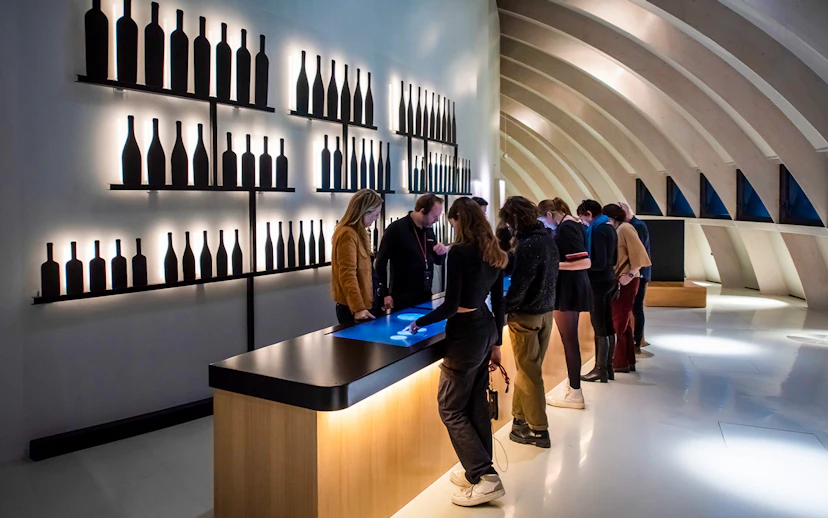
This is the permanent exhibition’s anchor piece — a large digital table that lets you explore wine regions, landscapes, and styles across the world. It’s one of the clearest places to understand what the museum is really about: not Bordeaux alone, but wine as a global cultural story. Most visitors tap a few regions and move on too quickly; it’s worth slowing down and comparing how geography changes the wine conversation.

Where to find it: Floor 2, early in the permanent exhibition, near the center of the main gallery sequence.

Vineyard Flyover

Type: Triple-screen immersive film

The Vineyard Flyover is the museum’s big visual reset: a cinematic sweep across vineyards in 17 countries that gives the visit scale very quickly. It’s especially good if the earlier screens feel dense, because it reminds you this place is built around atmosphere as much as facts. What most people miss is that the full loop is worth staying seated for — the transitions between regions are part of the point.

Where to find it: Floor 2, inside the permanent exhibition’s large-screen film area with bench seating.

Six Big Bottles

Type: Olfactory and sensory installation

These oversized bottle-shaped stations explain the main wine families through scent and simple interpretation, and they’re one of the easiest parts of the museum for non-experts to enjoy immediately. This is where the visit feels most hands-on rather than screen-led. Most visitors rush the smelling stage and read first; do it the other way around and the differences land much more clearly.

Where to find it: Floor 2, within the sensory section of the permanent exhibition.

Bordeaux documentary

Type: Short destination-specific film

If you came wanting more Bordeaux, this is one of the rooms you should make time for. It gives local vineyard context that the main exhibition only touches lightly, so it works as a correction to the museum’s otherwise global framing. Many visitors miss it because they assume the entire venue is already Bordeaux-focused and never go looking for the dedicated local section.

Where to find it: Floor 2, later in the permanent exhibition, near the Bordeaux-focused gallery content.

Wine and art

Type: Multimedia cultural gallery

This section connects wine to painting, music, cinema, and representation, which is why it feels more reflective than the more playful sensory rooms. It’s useful precisely because it slows the pace and shows the museum is about culture as much as production. Most visitors skim the art references too fast after the interactive rooms; it works better if you treat it as a short pause rather than another checklist stop.

Where to find it: Floor 2, in the mid-visit cultural galleries after the big sensory stations.

Belvedere

Type: Panoramic tasting bar and terrace

The Belvedere is the emotional finish to the visit: 1 included glass of wine or grape juice, a rotating selection, and a 360° view over Bordeaux and the Garonne. It is also the point where expectations matter most — this is a short tasting moment, not a guided flight. Most people focus only on the bar queue and miss the wine-bottle ceiling sculpture above them before stepping onto the terrace.

Where to find it: Floor 8, reached by lift after the permanent exhibition.

Facilities and accessibility

  • 🎒 Cloakroom / lockers: Free lockers near the entrance fit small bags up to 90 × 40 × 52 cm (35 × 16 × 20 in.), but suitcases are not accepted.
  • 🚻 Restrooms: Accessible restrooms are available on every floor, including near the Belvedere, though the top-floor one gets busier near sunset.
  • 🍽️ Cafe / restaurant / food stalls: Latitude20 is the casual ground-floor option, while Le 7 is the sit-down panoramic restaurant upstairs and works best with a reservation.
  • 🛍️ Gift shop / merchandise: The main boutique is on the ground floor and is strongest for wine books, accessories, and Bordeaux-specific bottles or gifts.
  • 🪑 Seating / rest areas: The Comfort Route adds rest points through the exhibition, which matters because most visits involve 2–3 hours on your feet.
  • 🅿️ Parking: Public parking is available nearby, including the Interparking opposite the museum, but there is no large free lot directly at the entrance.
  • 🩺 First aid / medical station: Staff are trained to assist, and reception is the first point to ask for help if you need support during the visit.
  • ♿ Mobility: Elevators reach every public floor, wheelchairs are available free at reception, accessible restrooms are on every floor, and the venue is certified across all 4 French Tourism and Disability categories.
  • 👁️ Visual impairments: A tactile path, Braille in elevators, and guide or assistance dog access make navigation easier than in many multimedia museums.
  • 🧠 Cognitive and sensory needs: Weekday mornings are the lowest-stress window, while Floor 2 becomes noisier and more crowded on weekend afternoons around the biggest screens and scent stations.
  • 👨‍👩‍👧 Families and strollers: The building is stroller-friendly, and the Junior mode on the Travel Companion makes the route more engaging for children ages 7–12.

Cité du Vin works best for school-age children who enjoy pressing, smelling, listening, and moving rather than standing in front of objects behind glass.

  • 🕐 Time: 2–2.5 hours is realistic with children, and the best sections to prioritize are the scent stations, the big film rooms, and the Belvedere at the end.
  • 🏠 Facilities: The stroller-friendly layout, elevators, accessible restrooms, and ground-floor food options make it easier than many city museums for families.
  • 💡 Engagement: Ask for Junior mode on the Travel Companion at the start, because it turns the exhibition into a more playful, age-appropriate experience.
  • 🎒 Logistics: Bring only a small bag, plan a restroom stop before going up to the Belvedere, and aim for a morning entry before the touchscreen areas get crowded.
  • 📍 After your visit: Bassins des Lumières is the easiest child-friendly next stop nearby if your group still has energy for another immersive space.

Rules and restrictions

What you need to know before you go

  • Entry requirement: A dated or valid ticket gets you in, and reduced-rate tickets only work if you bring the proof that matches the discount.
  • Bag policy: Small bags can go in the free lockers, but suitcases and bulky luggage are not accepted anywhere in the building.
  • Re-entry policy: Re-entry is not guaranteed on busy days, so leaving for lunch can mean losing access to the exhibition altogether.

Not allowed

  • 🚫 Food and drink: Food and drink are not allowed inside the exhibition, though you can eat in the public garden outside during opening hours.
  • 🚬 Smoking / vaping: Smoking and vaping are not allowed inside the venue.
  • 🐾 Pets: Pets are not allowed, but guide and assistance dogs are welcome.

Photography

Personal photography is generally fine in the building, the permanent exhibition, and the Belvedere as long as you follow any room-specific signs. Flash photography is not allowed, and temporary exhibitions may have tighter rules depending on the loans on display.

Good to know

  • The included ‘wine tasting’ is 1 small glass on the Belvedere, not a tasting flight, so book a workshop if that part matters to you.
  • Online tickets save the most time at the ground-floor desk, but they do not unlock a separate fast-track lane inside the museum itself.

Practical tips

  • Book the standard ticket a day or 2 ahead for summer weekends if you want a fixed slot, but book workshops, Via Sensoria, and Le 7 earlier — those are the parts that disappear first, not usually the base admission.
  • Start on Floor 2 and treat the first 30 minutes as warm-up only; if you spend too long at the first few screens, you’ll be the person rushing the Bordeaux section and Belvedere at the end.
  • The smartest crowd window is weekday mornings before 11am, because the Terroirs Table and scent stations are much easier to use before tour groups and afternoon visitors stack up around them.
  • Bring a small bag and leave big luggage elsewhere — free lockers handle small items well, but suitcases are refused and slow down the start of your visit.
  • If you care about the view, time your entry for about 90 minutes before sunset rather than arriving at sunset itself; you’ll get the light upstairs without hitting the worst late-day lift and bar queue.
  • Eat before you go in, or stay inside for food at Latitude20 or Le 7, because stepping out mid-visit is the easiest way to get caught by the museum’s re-entry limits on busy days.
  • Don’t book Cité du Vin expecting a deep Bordeaux appellation masterclass; if that is your main goal, pair it with a Bordeaux 360° workshop or a vineyard day-trip rather than relying on the permanent galleries alone.

What else is worth visiting nearby?

Commonly paired: Bassins des Lumières

Bassins des Lumières
Distance: 1.6km (1 mile) — 20-min walk
Why people combine them: Both are immersive, screen-led experiences in the same district, so they make sense as a half-day that stays indoors and doesn’t waste time crossing the city.
→ Book / Learn more

Commonly paired: Les Halles de Bacalan

Les Halles de Bacalan
Distance: 300m (0.2 miles) — 4-min walk
Why people combine them: It is the easiest pre- or post-visit food stop, especially if you don’t want to risk leaving the museum and finding re-entry restricted later.
→ Book / Learn more

Also nearby

Cap Sciences
Distance: 950m (0.6 miles) — 12-min walk
Worth knowing: It is another good indoor stop in the same riverside stretch, especially if you’re traveling with children or want something more hands-on after the museum.

Pont Jacques Chaban-Delmas
Distance: 600m (0.4 miles) — 8-min walk
Worth knowing: It’s worth the short detour for river views and a better look back at Cité du Vin’s exterior, especially in late-afternoon light.

Eat, shop and stay near Cité du Vin

  • On-site: Latitude20 is the practical ground-floor fallback for a quick plate and a glass, while Le 7 is the better choice if you want the view and have booked ahead.
  • Le 7 (same building, 7th floor): Modern French plates, higher prices, and one of the best dining views in Bordeaux — go for the setting rather than expecting destination fine dining.
  • Les Halles de Bacalan (4-min walk, 10 Quai de Bacalan): Food hall, mid-range pricing, and the most flexible option if your group wants different things without committing to a long sit-down meal.
  • Latitude20 (same building, ground floor): Wine bar and casual dining, moderate prices, and the easiest stop if you want to stay inside the venue after your visit.
  • 💡 Pro tip: If you want both the Belvedere and dinner views, reserve Le 7 for about 1 hour before sunset — that gives you time upstairs first without rushing the last part of the exhibition.
  • Cité du Vin Boutique: Wine books, accessories, gifts, and Bordeaux-focused bottles, right by the exit on the ground floor.
  • Latitude20 Wine Cellar: A 14,000-bottle cellar with about 800 retail labels, best if you want to buy wine more seriously than the main shop allows.
  • Les Halles de Bacalan: Good for edible souvenirs and regional food gifts if you want something less wine-heavy than the museum’s own store.

Bacalan works well for 1 night if you want to be near Cité du Vin, Bassins des Lumières, and newer riverside hotels, and it feels calmer than the old center. It is less charming after dark than central Bordeaux, though, so it is not the best all-round base for a first trip if you want to walk everywhere in the evening.

  • Price point: Mostly modern mid-range and upscale stays, with fewer budget options than around Saint-Jean or the center.
  • Best for: Visitors with an early museum slot, a river-focused itinerary, or a short stay built around Bacalan’s newer attractions.
  • Consider instead: Chartrons for a more lived-in neighborhood feel close to the river, or Saint-Pierre / Triangle d’Or if you want Bordeaux’s classic center, easier evening dining, and better first-trip walkability.

Frequently asked questions about visiting Cité du Vin

Most visits take 2–3 hours, though you should allow closer to 4 hours if you add a workshop, Via Sensoria, or a meal upstairs. The permanent exhibition alone is large enough to reward pacing, and the Belvedere works best when you are not rushing the last 20 minutes before closing.

More reads

Cité du Vin tickets

Cité du Vin highlights

Getting to Cité du Vin

Bordeaux travel guide